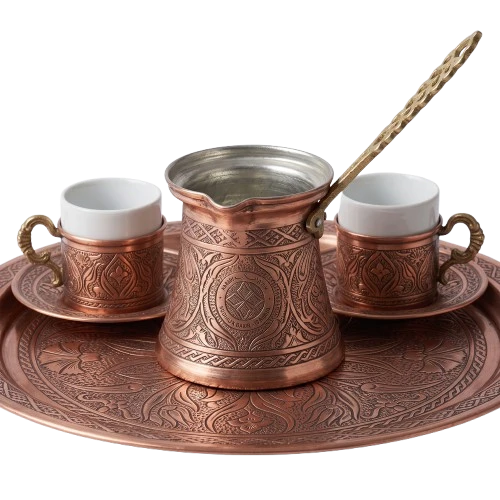
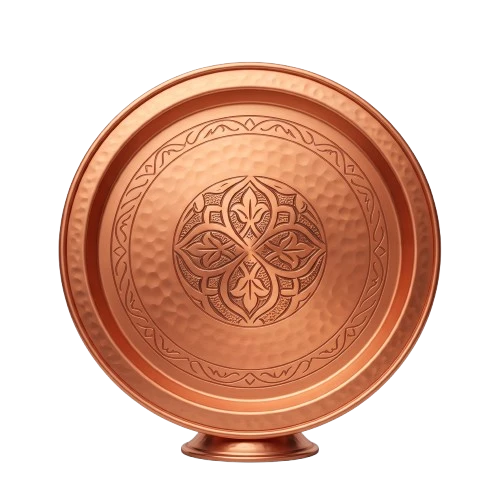
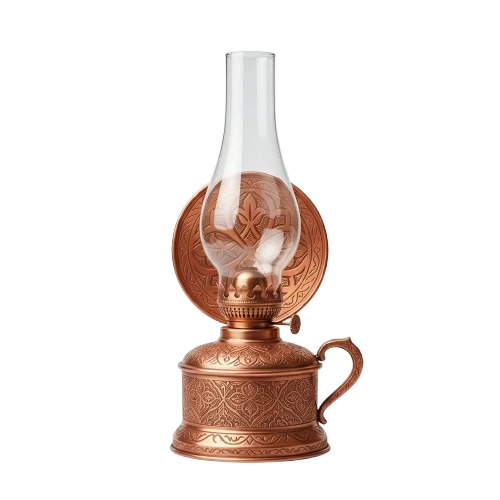
Buying copper by the crate is a different job from buying one piece. The tray you liked in the photo is fine; your real question is whether all fifty will be that good. Most trouble on corporate orders comes from things nobody asked about at the start.
Ask for a sample first
A catalogue photo tells you nothing. Order one or two samples, hold them, weigh them. Paying for a sample is normal practice, and a serious producer deducts it once the order is confirmed. Three things to look at: weight, the tin on the inside, and how the rim and base are joined.
Tin and wall thickness
Anything that touches food needs a tin lining inside. Hold the piece to the light and check whether the tin is even, whether it pooled at the bottom, whether the sides were left bare. Do not resell an untinned decorative item as cookware; the returns become your problem, not the supplier's.
Wall thickness sets the price more than anything else. For decorative pieces 0.6 mm is enough; for pots, coffee pots and trays in daily use ask for 1 mm or more. On hotel and restaurant orders do not go below 1.2 mm. A seller who cannot state the thickness either does not know it or does not want to say it.
Will all fifty match
Hammer marks on handmade pieces are never identical, and nobody should expect them to be. Dimensions, weight and handle angle are another matter. We work to a 3 percent weight tolerance within a batch, and no tolerance at all on lids: every lid has to sit on every body. Put that in the order in writing.
How tiered pricing works
Unit price drops as quantity rises because die preparation, machine setup and the tinning bath are one time costs. At 10 pieces you are close to retail, at 50 the drop is obvious, and past 200 the price settles onto the kilo cost of copper and goes no lower. Copper is a traded commodity, so quotes usually hold for 7 or 15 days. Ask how long yours is valid.
Lead time and invoicing
Stock items ship in 2 to 3 days. Made to order, 50 pieces takes 10 to 15 days and 300 pieces 4 to 6 weeks. Add 5 to 7 days for die making if a logo goes on.
Settle the invoice details before production starts: tax number, billing address, payment terms. The sample is invoiced separately.
Logos and reordering
There are three ways to put a logo on copper: stamping with a die, laser engraving, acid etching. A die costs money the first time, but past 100 pieces it is the cheapest per unit, and since we keep the die you do not pay for it again on the second order.
Buy through a middleman and the die is not yours. Ask for the same product three months later and the work may have moved to another workshop, leaving you with nothing. That is the real argument for dealing with the producer: two years on, a broken piece is replaced by its twin.