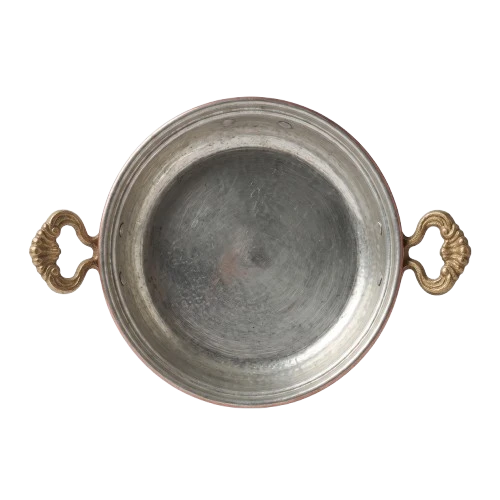
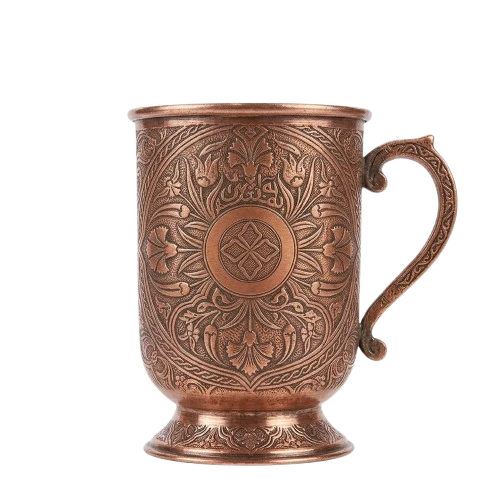
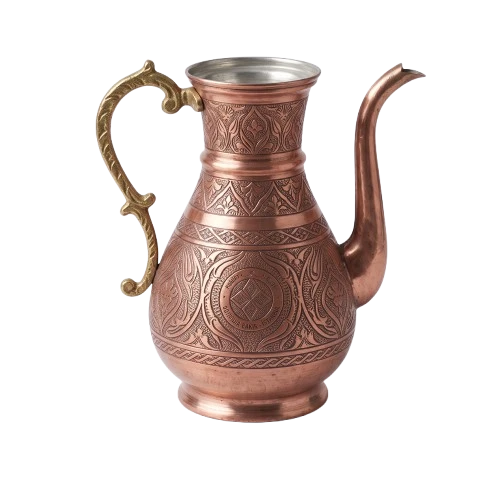
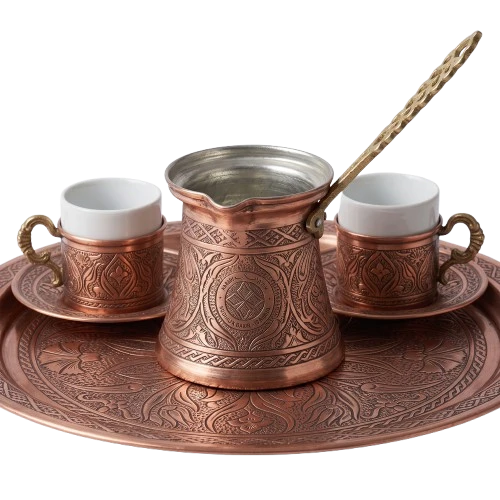
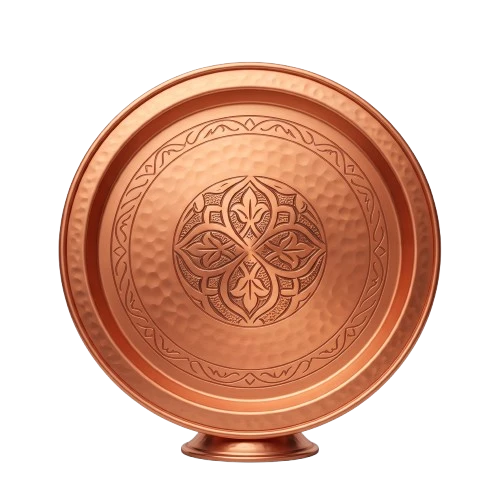
A tray shows copperwork better than any other piece: the wide flat surface carries every hammer mark and every chiselled motif. Ours are raised from a single sheet, with the rims turned by hand. Trays intended to carry food are tin-lined; purely decorative ones may be left as bare copper.
The rim does the structural work. A flat disc of copper has almost no rigidity, so we roll the edge over on itself or turn it up into a lip; that single fold is what stops a 50 cm tray bending under a full teapot. On the big pieces the rim is worked over a wooden stake in dozens of small passes, and that is where most of the making time goes.
Trays of 25 to 35 cm (10 to 14 in) are for tea and coffee service. From 40 to 50 cm (16 to 20 in) they serve a family table; 60 cm (24 in) and above belong to the traditional floor table and to wedding service. Footed trays act as a low table in themselves. On engraved models the motif is punched by hand with a chisel, it is not printed.
Weight climbs quickly with diameter. A 40 cm tray in 1 mm copper runs about 1.5 kg; a 70 cm sini is a piece of furniture and should be treated as one.
Hand chiselling leaves a mark you can feel. Run a finger across a genuine engraved tray and the lines have depth and a slightly irregular edge, because a chisel is struck one blow at a time. Printed or acid-etched decoration is flat and repeats perfectly. The older motifs are rumi scrollwork, tulip and carnation forms, and geometric borders.
A hot teapot or pan can be set down directly. Wash by hand in warm water and dry; left wet, the surface develops dark spots. Decorative trays for the wall can take a hanging ring on the back. A monthly pass with copper polish keeps the shine, or leave it alone if you prefer the patina.
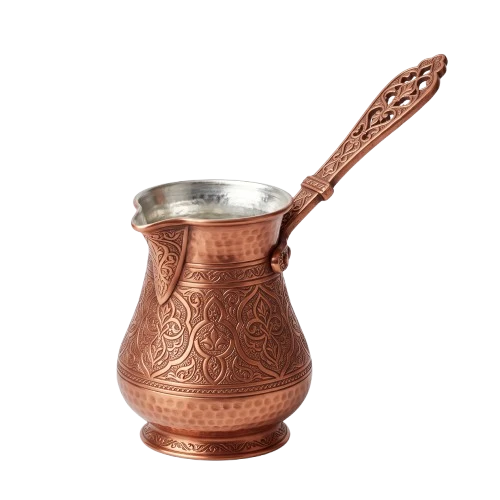
Tin-lined copper goes in below 200 C; an unlined tray does not go in at all. The limit is set by the tin inside, not by the copper.
Read the article
How the diameter is measured, what each size from 20 to 50 cm is for, how many cups fit on a tray and why the rim height matters.
Read the article
The kilo price of the metal, the hours of work and the tinning. Why two pieces that look alike carry different prices, and why wholesale comes out lower.
Read the article