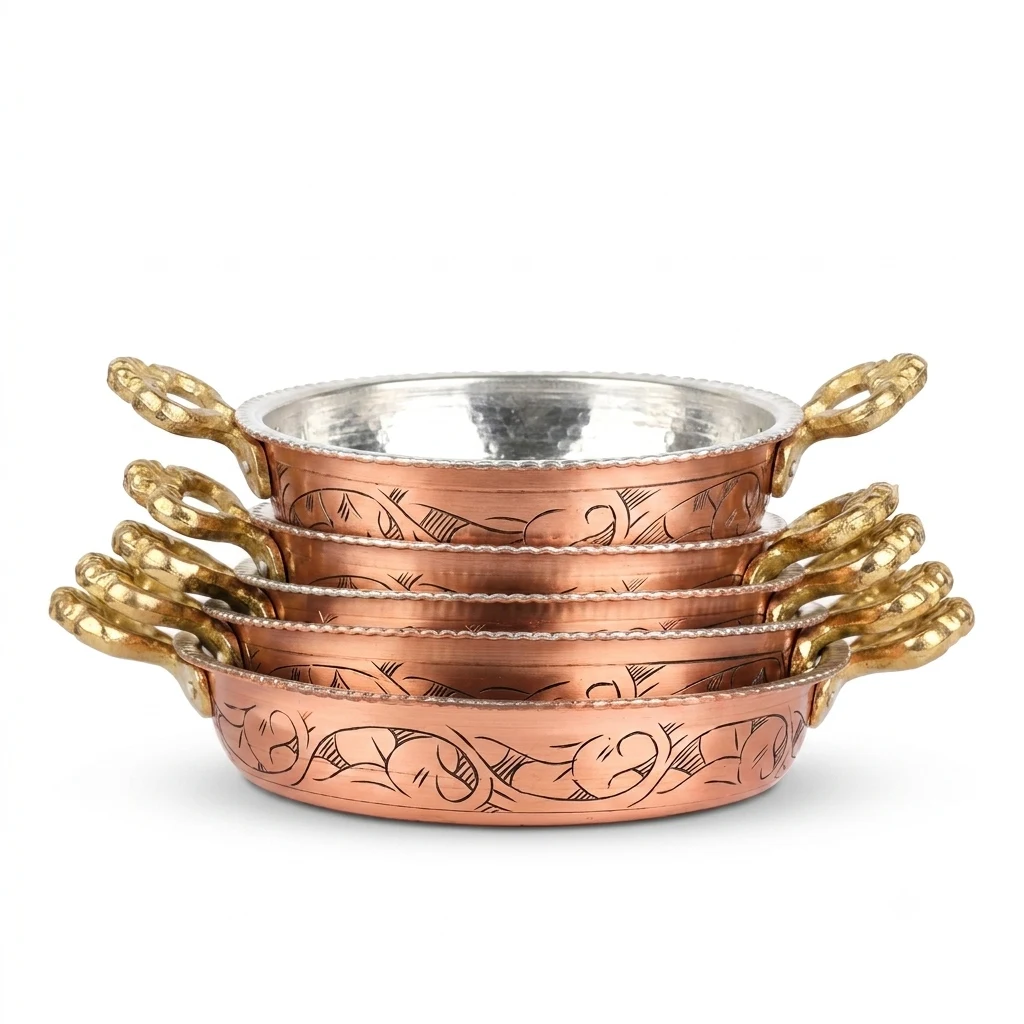
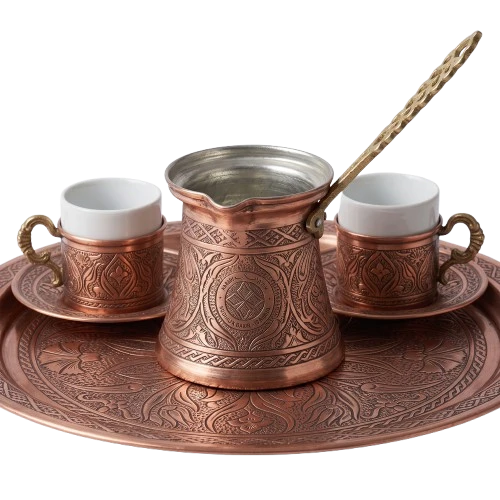
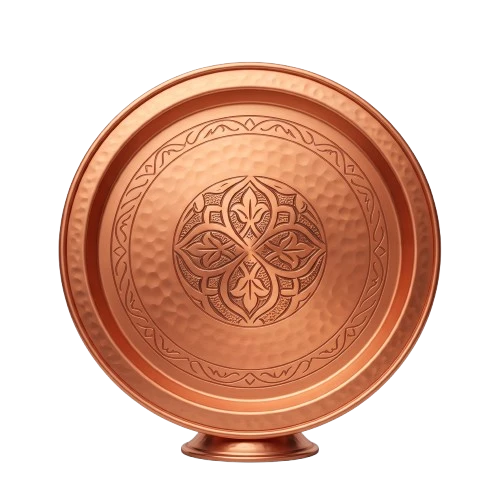
When you buy a copper piece, what you can see is the shape and the shine. What decides how long it lasts and how it behaves on the hob is the wall thickness, the gauge of the sheet in millimetres. Two trays in the same photograph can be 0.7 mm and 1.2 mm. Most of the price difference sits right there, because copper is bought by the kilo.
What changes between 0.7 mm and 1.5 mm
The numbers look close together; the second is more than double the material. In practice it shows up like this:
- Denting. A 0.7 mm tray knocked against a table edge keeps the dent. At 1.2 mm the same knock leaves nothing.
- Holding its shape. The rim of a pan pressed from thin sheet goes slightly oval after a few years of washing up.
- Heat. A thin base passes the flame straight through and a hot spot forms in the middle of the pan. A thick base spreads that same heat sideways before it reaches the food.
- Sound. You can test this in a shop. Tap thick copper with a finger and you get a long, low ring; thin sheet answers with a short, tinny rattle.
Pressed against hand-hammered
Cheap production presses a thin sheet into a die. The process stretches the metal, so the base and corners end up thinner than the sheet started. A pan made from 0.8 mm sheet can be down to 0.5 mm somewhere.
Hammering works the other way. We start with a thick plate, the hammer moves the metal in a controlled way, and thickness stays where the piece needs it. The hammer marks are not only decoration; the work hardens the surface and makes it more resistant to knocks. Hammering the base of a cauldron takes half a day in our workshop, and the piece lives off that half day.
Weight is thickness you can measure at home
Without callipers, look at the weight. The density of copper is fixed, so between two pieces of the same diameter the heavier one is thicker. A concrete case: a flat 30 cm tray comes in around 450 g at 0.7 mm and 650 to 700 g at 1 mm. At 40 cm the same gap widens to somewhere between 800 g and 1.2 kg.
If a listing does not give a weight, ask for it. A seller who leaves it out usually has no figure worth quoting.
What to expect per item
- Turkish coffee pot: 1 to 1.2 mm. Any thinner and the sugar catches on the bottom and burns.
- Pans, pots, casseroles: 1.5 to 2 mm base, 1 to 1.2 mm walls.
- Cauldrons: 2 mm and up. A long boil puts the base under real load.
- Serving trays: 0.8 to 1 mm is enough. On a decorative wall tray 0.6 mm is normal.
- Samovar body: 0.8 to 1 mm. Thicker only adds weight.
- Mugs and cups: 0.9 to 1.2 mm. Thin ones crack where the handle meets the body.
There is no point hunting for 2 mm copper in a panel that will hang on a wall; you pay for it in shipping and price and nothing else. In a pot that goes on the fire, thin sheet announces itself in the first year.